


Introduction
When picking a US residential proxy, most attention goes to country, city, and purity — but one key piece is often ignored: which ASN (operator) is behind the IP.
A US residential IP from Comcast, AT&T, or Verizon can be perceived differently by target platforms. This article explains in plain terms what an ASN is, the ASN list and network traits of major US ISPs, and how to choose per business scenario.
Compliance boundary: this article only covers compliant access to public data / public APIs and normal business operations, respecting target platforms’ terms of service.
1. What Is an ASN and Why It Matters for Residential Proxies
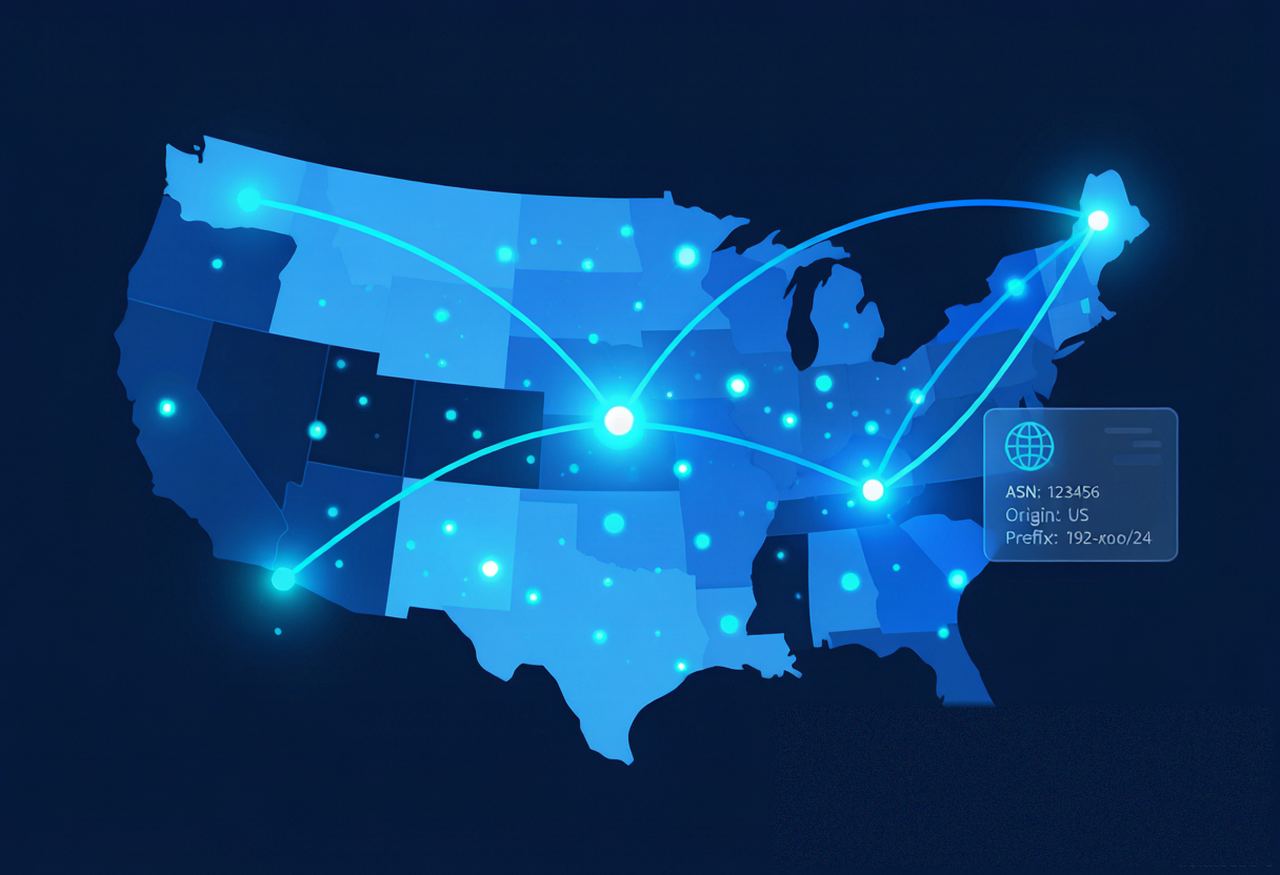
An ASN (Autonomous System Number) is the operator’s “ID card,” showing who owns and runs a block of IPs. Checking the ASN reveals three things:
- Network type: residential broadband, mobile, or hosting;
- Operator identity: large ISPs like Comcast / AT&T / Verizon, or small unknown companies;
- Trust impression: large well-known operators usually look more “normal” and closer to real users.
For residential proxies, the ASN decides “which ISP’s broadband user this IP looks like” — more informative than just the country.
2. Major US ISPs and Their Common ASNs
| ISP | Common ASN | Network type | Perception in proxy market |
|---|---|---|---|
| Comcast Xfinity | AS7922 | Cable Broadband | One of the most common ASNs in US residential proxies |
| AT&T | AS7018 | Fiber / DSL Broadband | Traditional US telecom broadband |
| Verizon | AS701 | Fiber / Broadband | Strong Northeast coverage |
| Cox Communications | AS22773 | Cable Broadband | Regional US broadband |
| Charter Spectrum | AS20115 | Cable Broadband | Huge residential user base in the US |
Note: some operators also have sub-ASNs (e.g., Verizon Wireless AS6167); the table lists the most common ASNs on residential/fixed networks — refer to official operator sources and public databases for details.
3. How to Choose by Business Scenario
| Scenario | Better fit | Why |
|---|---|---|
| E-commerce / store operations | Comcast, AT&T | Large home broadband, high acceptance, broad coverage |
| Social media multi-account | All three | Stability and region match matter more; brand less so |
| Ad delivery / local verification | Target the local mainstream broadband | Verizon Fios is more common in NY, NJ, PA and other Northeast areas; Comcast Xfinity has a huge home-broadband base across many states |
| Payments / logins (high-trust) | Large well-known operators | More “common” than niche ISPs; network identity looks more credible (a tendency, not a rule) |
| Large-scale data collection | IP quality and rate control matter more | ASN matters less; datacenter proxies are usually the better fit here |
In one line: ASN is your IP’s “network origin”; the business scenario decides which origin fits best.
4. Common Misconceptions
- Myth 1: a big-name ASN never gets banned. Wrong. Whether you get blocked depends on IP quality, target platform, and usage — operator brand isn’t a free pass.
- Myth 2: one ASN is always better than another. Wrong. No absolute best among mainstream operators — only “better matched to a scenario.”
- Myth 3: ASN decides everything. Wrong. ASN is only part of network identity; purity, stability, and region match matter too.
5. FAQ
Which ASN should I pick for a US residential proxy?
No universal answer — clarify your scenario (social, e-commerce, ad verification), then match the region’s mainstream operator.
Is a Comcast proxy good?
Comcast has a huge home-user base and a common network identity — fine for most regular tasks; specifics still depend on IP quality and usage.
Does the ASN affect getting banned?
It’s one risk-control signal, but usually not decisive; large well-known ISPs generally look more “ordinary” than niche operators.
6. How to Check a Residential Proxy’s ASN
Common ASN lookup sources include IPinfo, MaxMind, IP2Location, and BGP.tools (examples only, not endorsements). A lookup result typically contains fields like these:
IP: 203.0.113.10
ASN: AS7922
Organization: Comcast Cable Communications
Type: Broadband
Country: United States
(Demonstration format only — not a real lookup result.)
Reminder: different databases may return different ASN results for the same IP; treat the ASN as a reference, not a standalone quality verdict.
7. Conclusion
When choosing a US residential proxy, the ASN is the “second ID card” worth reading: Comcast, AT&T, Verizon and other mainstream operators each have their coverage and traits — no best, only better-matched. Combine business scenario, target region, and IP quality rather than just “US.”
Resource note: for example, IPNut provides static ISP proxy resources across multiple regions including the US — choose the network type by ASN, region, and business needs; for bulk collection, static datacenter proxies are usually more economical.