


Introduction
Almost everyone new to proxy IPs takes the same first step: search for “free proxy list” or install a free VPN. On the surface, it’s free — so it seems like a bargain.
But after a few real projects, many people flip: they’d rather pay a monthly subscription than touch free proxies again. Not because they enjoy spending, but because the hidden costs of free proxies usually outweigh that subscription fee.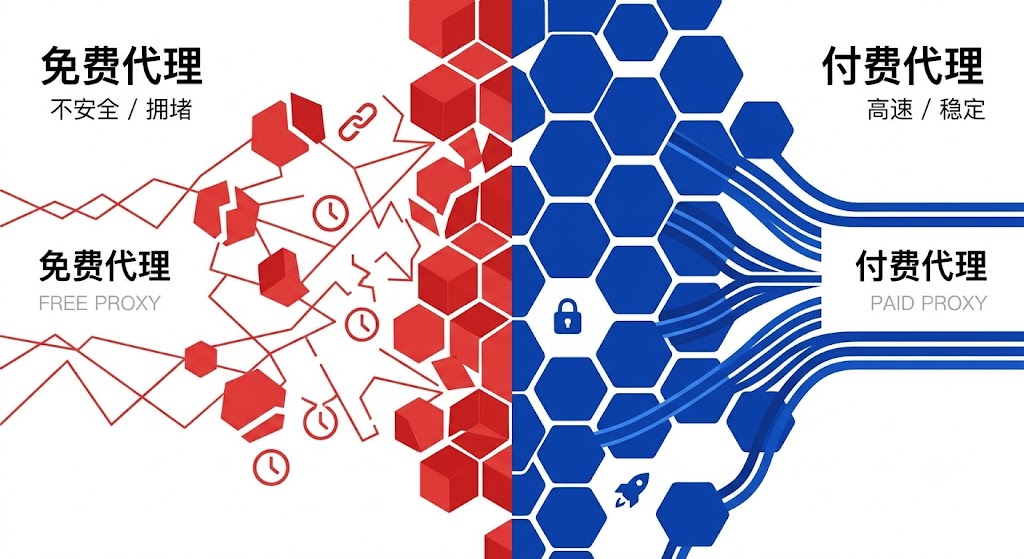
This article breaks down what “free” actually costs, then shows where paid — especially static dedicated — proxies genuinely deliver value, so you can price the trade-off correctly.
Note: Everything below assumes compliant use cases (data collection, account management, rank tracking, etc.) and excludes any illegitimate purpose.
1. What “Free Proxies” Actually Are
“Free proxies” usually mean one of these:
- Public proxy lists: open proxy IPs circulating online that anyone can connect to;
- Free VPNs / free proxy tools: clients marketed as “free”;
- Open relays / throwaway nodes: unmaintained exits set up temporarily.
Their common trait: unknown source, open to everyone, owned by no one. The reason they’re free is often ads, traffic monetization, or treating your browsing behavior itself as the product — which is already the first red flag.
2. The Hidden Costs of Free Proxies
Take “free” apart and the real price hides in the following places:
| Hidden Cost | What It Looks Like |
|---|---|
| Security risk | Traffic passes through someone else’s server — possible eavesdropping or MITM attacks; credentials and cookies can leak |
| Privacy illusion | Operators typically log activity, sometimes resell it; “anonymity” is often a myth |
| Poor IP quality | The same IP used by countless people is usually already blacklisted; one use and you’re blocked |
| Extreme instability | Overloaded nodes, frequent drops, slow speed — critical tasks break anytime |
| No support / no guarantee | No one to turn to when things fail; no SLA; you eat the loss |
| Compliance fallout | Free proxies are widely abused, so their IP reputation is poor and can drag your business down by association |
One line: free proxies save the subscription fee but bet your accounts, data, and project itself.
3. Three Real Scenarios Where “Free” Costs More
Scenario 1: The scraper crashes
You run collection on free IPs. A few days in, the target site blocks the whole batch — collection fails, hours wasted, and you restart from scratch. The proxy fee you saved can’t fill that rework hole.
Scenario 2: Social / e-commerce account banned
An account logs in through a free proxy; the platform flags the IP as a “high-risk exit.” At best throttled, at worst banned. A mature store or matrix account is worth far more than a few dollars a month.
Scenario 3: Sensitive data leaks
Routing traffic with customer info or login credentials through a free proxy is handing the keys to a stranger. Once leaked, the cost (liability, reputation, compliance penalties) dwarfs any proxy bill.
Takeaway: a free proxy’s “expense” isn’t on the price tag — it’s in the cascading loss when it fails.
4. What Paid Proxies (Static Dedicated) Actually Deliver
“Paid proxy” isn’t a vague idea; the value is concrete:
- Dedicated IP (not shared): each IP is yours alone, never contaminated by someone else’s behavior;
- High purity / high trust: clean IPs are far less likely to be flagged as proxy or blacklisted;
- Stability + SLA: e.g., 99.99% uptime, safe for production;
- Support + compliance: someone to help when things break, and alignment with GDPR / CCPA;
- Predictable cost: monthly or usage-based billing keeps budget under control.
Take IPNut as an example: its static residential ISP proxy comes from real home broadband and is 100% dedicated — ideal for account management and rank tracking where you must “look like a real user.” Its static datacenter proxy offers high volume at lower cost with unmetered traffic, suited to bulk collection at scale. Both cover 220+ countries/regions and include bilingual support.
5. Free or Paid? A Decision Checklist
Before you decide, ask three questions:
- How important is this task?
- Practice / temporary / low-risk → free is fine to try (but don’t send sensitive data)
- Production / accounts / business → go straight to paid static dedicated
- How clean must the IP be?
- High trust, afraid of bans → paid dedicated static residential
- Can you afford the loss if it fails?
- No → don’t gamble with free proxies
Rule of thumb: free saves pocket change but bets the big risks; paid is a cost, but also insurance.
Conclusion
“Free vs paid proxies” was never about “which is cheaper” — it’s about how much you’re willing to pay for stability, security, and compliance.
For teams seriously running businesses, managing accounts, or collecting data, the hidden cost of free proxies almost always exceeds the subscription. That’s exactly why more teams end up on dedicated static proxies: not necessarily the cheapest, but the least likely to fail at the worst moment.
This article is based on publicly available industry materials, focused on positioning and risk comparison, with no vendor-specific pricing. Proxy pricing and packages are subject to change — refer to each official site for the latest information.