



When choosing a proxy, you often see terms like “clean IP” and “fraud score,” but few explain what they really are, how they’re calculated, or how to interpret them. This article breaks down the concept of IP purity, the mechanics of blacklists and fraud scoring, and tells you what to take seriously vs. what not to over-obsess about. It covers publicly known detection mechanics and industry knowledge only, and does not endorse any detection tool’s scoring as a standard.
1. What “IP Purity” Actually Means
“Purity” is not an official standard, and there is no single “IP purity score” used by all platforms — it’s an industry shorthand for an IP’s overall risk status, typically covering:
- Blacklist status: whether the IP is flagged by security services (anti-spam, anti-fraud databases)
- Fraud score: the “risk level” rating assigned by security databases
- Type label: residential / datacenter / proxy flags (network ownership)
- History: whether the IP has been associated with suspicious activity
In one line: purity is “the IP’s reputation in the network security ecosystem.” Good reputation = fewer flags; bad reputation = more flags. But note: it’s a general reference, not an official unified standard.
2. How Blacklists Form
Blacklists are maintained by security vendors. An IP gets listed typically because:
- Historically used for spam or mass messaging
- Associated with known malicious behavior (fraud, credential stuffing, etc.)
- Long-term shared use by many users/accounts, which may generate abnormal behavior or risk associations and affect the IP’s reputation
- Reported in security incidents such as malicious scanning, attacks, or anomalous access
Key insight: blacklists are dynamic — an IP flagged today may be cleared tomorrow, and vice versa. Different vendors’ lists also differ from each other; one tool may show a flag while another shows clean.
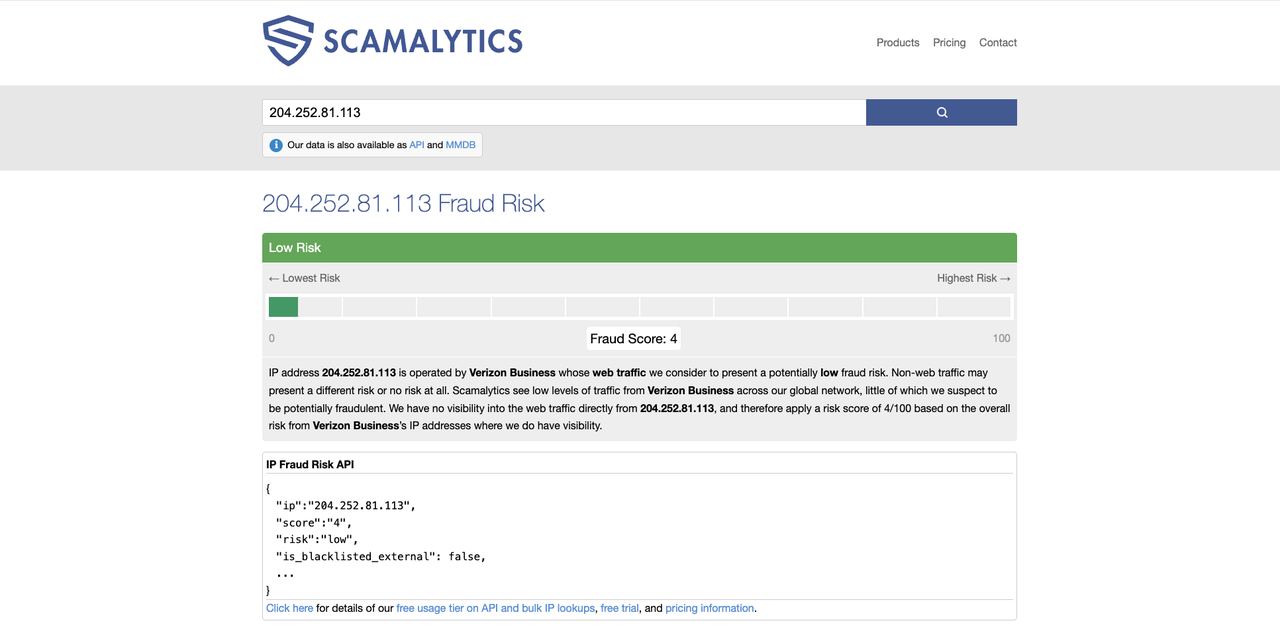
3. How Fraud Scores Are Calculated
A fraud score is a “risk score” a security database assigns to an IP. Common inputs:
| Dimension | Explanation |
|---|---|
| IP type | Some risk models assign higher risk weight to network types like Hosting, Proxy, or Data Center |
| Geolocation / network region | Some models may factor in regional historical risk data |
| ASN history | Past risk record of the operator/hosting provider |
| Shared traces | Whether the IP has long been shared by many accounts |
| Behavioral patterns | Similarity to known fraud patterns |
Important: these scores are algorithmic outputs from security vendors, not official standards. Different platforms can rate the same IP differently — which is exactly why a score is a reference, not a verdict.
4. How to Interpret These Scores (Practical Advice)
Worth referencing:
- IP type label (residential vs datacenter) — a relatively stable signal
- Obvious blacklist flags — indicates recent negative records; use with caution
Not worth obsessing over:
- The exact score (standards differ across vendors; the same IP can score very differently)
- A single field from a single tool (prefer cross-checking multiple tools)
Core advice: detection tools help you understand an IP’s objective status, not deliver a “good/bad verdict.” What really matters is how the IP performs in your actual use case.
5. FAQ
Q: Does a high fraud score mean the IP is definitely problematic?
A: Not necessarily. Scores are outputs of vendor models and vary widely across vendors. A high score means “this vendor considers it elevated risk”; whether it affects you depends on whether the target platform uses that vendor’s data.
Q: How can I keep an IP “clean”?
A: Mostly by choice and habits: pick proxies from reputable sources, reasonably control the degree of exit IP sharing based on your business scenario (avoid many unrelated accounts sharing the same exit long-term), and don’t use it in anomalous environments. Whether the provider recycles expired IPs also affects long-term reputation (expired-and-not-recycled, resource-isolated practices help).
Q: Does a low score in a detection tool affect after-sales?
A: We don’t recommend using third-party detection scores as a judging standard — results vary greatly across tools and scoring changes over time. Real usability in your business is the true test; if you hit issues, contact the provider directly.
6. Summary
IP purity = the combined reputation of blacklist status, fraud score, and type label, dynamically computed by security vendors — not an official standard, and results differ across databases. Use it right: reference type labels and obvious blacklist flags, don’t obsess over single scores; judge suitability by actual performance.
To figure out which network type your IP is, start with Native IP vs Datacenter IP. For stable, well-sourced exit environments, IPNut‘s Static Residential ISP and Static Datacenter IPs both support no-recycling after expiry — that’s a feature of the resource usage/recycling mechanism; an IP’s reputation in detection databases still depends on external databases and historical status. Choose by scenario and use detection results as reference.