


People working in cross-border e-commerce, brand globalization, or content marketing often run into the same situation: one Instagram account grows well, and when they try to replicate it with a second or third account, the new accounts get flagged as “bulk registration” before they can gain traction. They end up with limited reach at best, or a disabled account at worst. The problem is usually not the content, but the network environment behind the accounts. This article explains how Instagram’s risk-control logic works and how to choose and configure IPs for multi-account operation. It only discusses public information and public interfaces, and we always recommend following Instagram’s Terms of Service and local laws.
Why Instagram Associates Multiple Accounts on the Same Network
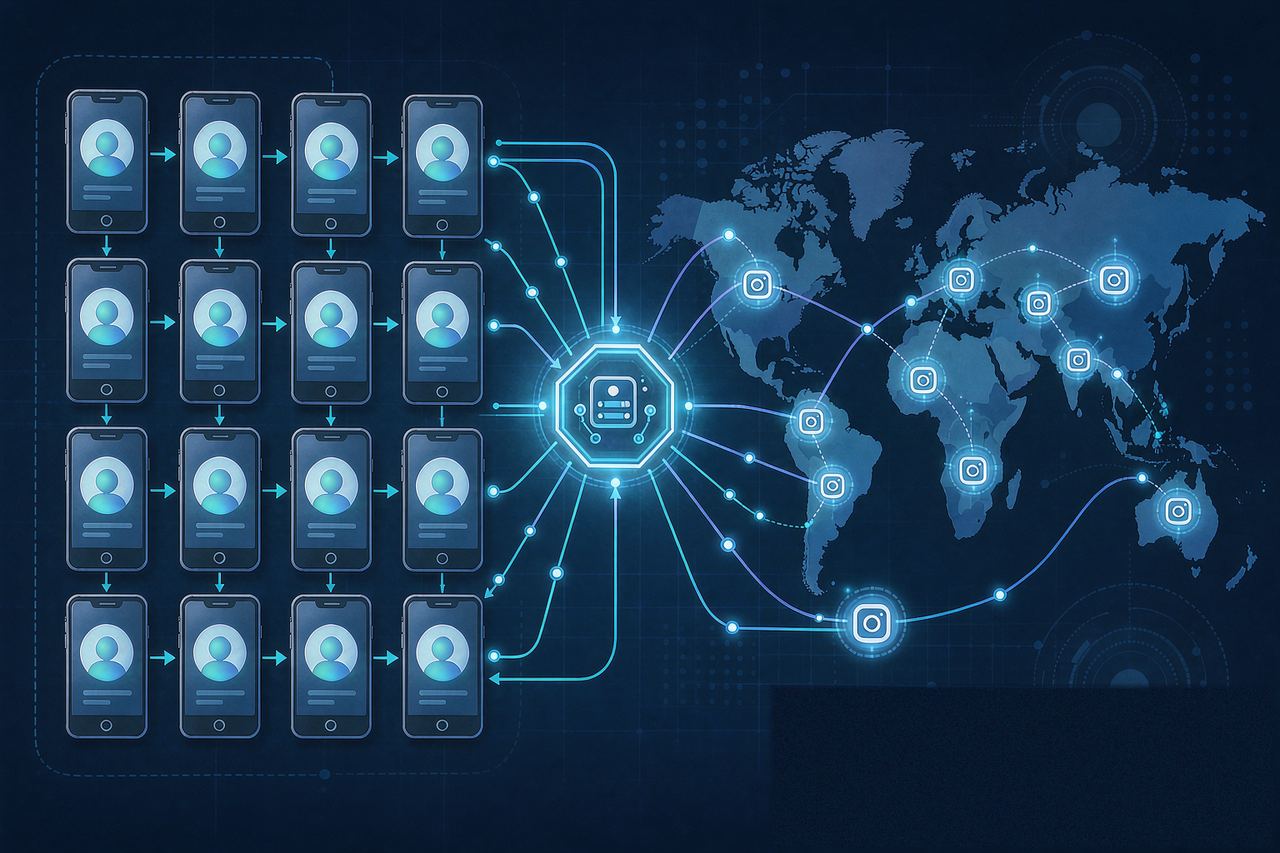
Instagram is part of the Meta platform, and its risk-control system evaluates account behavior across multiple dimensions. When several accounts share the same network egress within a short period, the system groups them under the same “network fingerprint” and may infer that they belong to the same operator. If one of those accounts behaves abnormally, the others face a significantly higher risk of being evaluated as well.
It is worth clarifying that what we discuss here is publicly known or industry-recognized risk-control knowledge, not any method to crack or bypass platform mechanisms. The essence of compliant operation is to give each account an as independent and stable network identity as possible.
Three network factors mainly affect account independence:
- Whether the egress IP overlaps with other accounts
- Whether the IP’s geographic location stays consistent over time
- Whether the IP changes frequently or belongs to an overused network range
What Kind of IP to Choose: Static Residential IP vs. Datacenter IP
For multi-account scenarios, proxy IPs fall into two broad categories, and they perform quite differently in Instagram operation.
| Dimension | Static Residential IP | Static Datacenter IP |
|---|---|---|
| IP source | Residential network resources allocated by ISPs | IP ranges allocated from datacenter server rooms |
| Platform recognition | Close to real user network environments | More easily recognized as server egress |
| Stability | Fixed, suitable for long-term operation | Fixed, suitable for auxiliary scenarios |
| Best for | Main operating accounts, account warming | Batch testing, registration assistance, low-frequency tasks |
| Cost positioning | Relatively higher | More economical |
Static residential IP is the first choice for most Instagram operators running multiple accounts. It comes from residential network resources allocated by internet service providers, so from the platform’s perspective it looks much closer to an ordinary user’s network environment. The IP is also fixed, allowing each account to use the same egress over the long term, which fits the needs of account warming and stable operation. If you need a long-term stable residential network identity for each account, a static residential ISP IP solution is worth considering.
Static datacenter IP is more affordable, but the ranges come from server rooms, and platforms can recognize such egress more easily. Using it as the egress for core operating accounts carries higher risk. It is better suited to auxiliary tasks that do not involve core accounts, such as batch testing or data verification. When cost matters, it can serve as a supplement — see the static datacenter IP options.
Dynamic IP vs. Static IP: Trade-offs in Account Warming
Dynamic residential IPs rotate the egress address on a schedule. They suit tasks that need frequent identity changes, such as data collection or price comparison. But for Instagram account operation, frequently changing IPs can trigger abnormal-login alerts and, over time, hurt account stability. That is why this topic emphasizes “static”: matching one account to one fixed IP is the closest behavior to a real user.
There is no absolute standard for how many accounts a single IP can carry. The common industry practice is “one account, one IP.” When the number of accounts is not large, it is better to reduce how many accounts share a single egress than to let multiple accounts reuse one IP. IP quality itself also matters — you can refer to the dimensions covered in how to judge proxy IP quality.
A Practical IP Setup Approach for Multi-Account Operation
Putting the principles above into practice, you can follow these steps:
- Plan the accounts first: Clarify the positioning, target region, and operating cycle of each account. Decide the number of accounts first, then work backward to determine how many independent IPs you need.
- Choose the IP type: Use static residential IPs for main accounts, and static datacenter IPs for auxiliary tasks to control costs.
- One account, one IP: Bind each account to an independent egress IP. Registration, login, and daily operation should always go through the same egress.
- Combine with browser isolation: Use independent browser profiles so that cookies, fingerprints, and other browser-level data do not cross-contaminate.
- Avoid frequent switching: Perform daily operations in a stable network environment, and minimize jumping between multiple locations and egresses.
Common Misconceptions
- Mistake 1: Using datacenter IPs for new accounts is fine. New accounts are at their most fragile stage. Registration and early warming should use static residential IPs that resemble real user environments.
- Mistake 2: The more often you change IPs, the safer you are. For operating accounts, the opposite is true. Frequent IP changes are more likely to trigger abnormal alerts.
- Mistake 3: Occasionally switching IPs between accounts is harmless. Any trace of cross-use between accounts strengthens the inference that they belong to the same operator.
- Mistake 4: Only looking at the IP and ignoring the whole environment. The IP is only one part of the network identity. Browser fingerprint and operation behavior matter just as much and must work together.
FAQ
Q: How many Instagram accounts can one static residential IP carry?
There is no publicly stated standard number. To be safe, assign one independent IP per account, and expand account by account as the number grows.
Q: My Instagram account is limited. Can changing the IP fix it?
Changing the IP only alters the network egress; it does not replace a review of whether the content and behavior are compliant. First check whether the account itself violates any rules, then consider adjusting the network environment. If an account gets disabled, the troubleshooting ideas in what to do when your proxy IP is banned can help.
Q: Are static datacenter IPs completely unusable?
They can be used in auxiliary scenarios such as testing and data verification that do not involve core accounts. As the egress for main operating accounts, however, the risk is higher.
Q: Do I have to use a proxy IP for multi-account operation?
If your accounts all operate under the same real network for a long time, the risk of being evaluated as related rises significantly. The value of a proxy IP is giving each account an independent network identity. Whether to use one depends on your account scale and operating approach.
Summary
The core of Instagram multi-account operation is not about “hiding” but about “independence”: each account should have a stable, independent network identity that resembles a real user, reducing the chance of being evaluated as related from the source. The IP is the most critical piece — prioritize static residential IPs for main accounts, use static datacenter IPs for auxiliary tasks, and combine browser isolation with stable operating habits so your account matrix can go further.
If you are planning a multi-account matrix, you can check out the static proxy solutions at IPNut. It offers dedicated IPs covering multiple countries and regions, with both residential and datacenter lines available on demand — suitable for long-term, stable account operation scenarios.