



“I bought a US proxy, but the detection shows LA while the platform displays somewhere else.” “Is an inaccurate location a sign of a bad IP?” — one of the most common questions among proxy users. This article explains where IP geolocation comes from, why deviations happen, when to worry, and when it’s usually fine.
1. Where Does IP Geolocation Come From?
An IP’s “location” is not an inherent attribute of the IP — it’s mapped by third-party geolocation databases based on IP info. In other words:
- An IP’s allocation and network ownership info can usually be judged through registration data, ASN, Organization, and similar fields
- But “which city this IP is in” is a database-mapped result
Different databases (IPinfo, IP2Location, MaxMind, etc.) have different data sources and update frequencies, so their judgments on the same IP can differ — this isn’t an IP problem, it’s a database difference.
2. Why Deviations Happen (Three Common Causes)
1. Different platforms use different data sources
The “location” you see depends on which database the platform uses. The same IP may show LA on site A and a different city on site B — just two databases’ different results.
2. Database update lag
When IP ranges are reassigned or operators adjust ownership, databases take time to update. When a database is outdated, it displays the old location.
3. Country-level vs city-level precision
Geolocation precision usually has two levels: country-level and city-level. Country-level is usually more stable than city-level, but it’s not absolutely accurate either — when IP ranges migrate, are reassigned, or databases lag, country-level results can also be wrong.
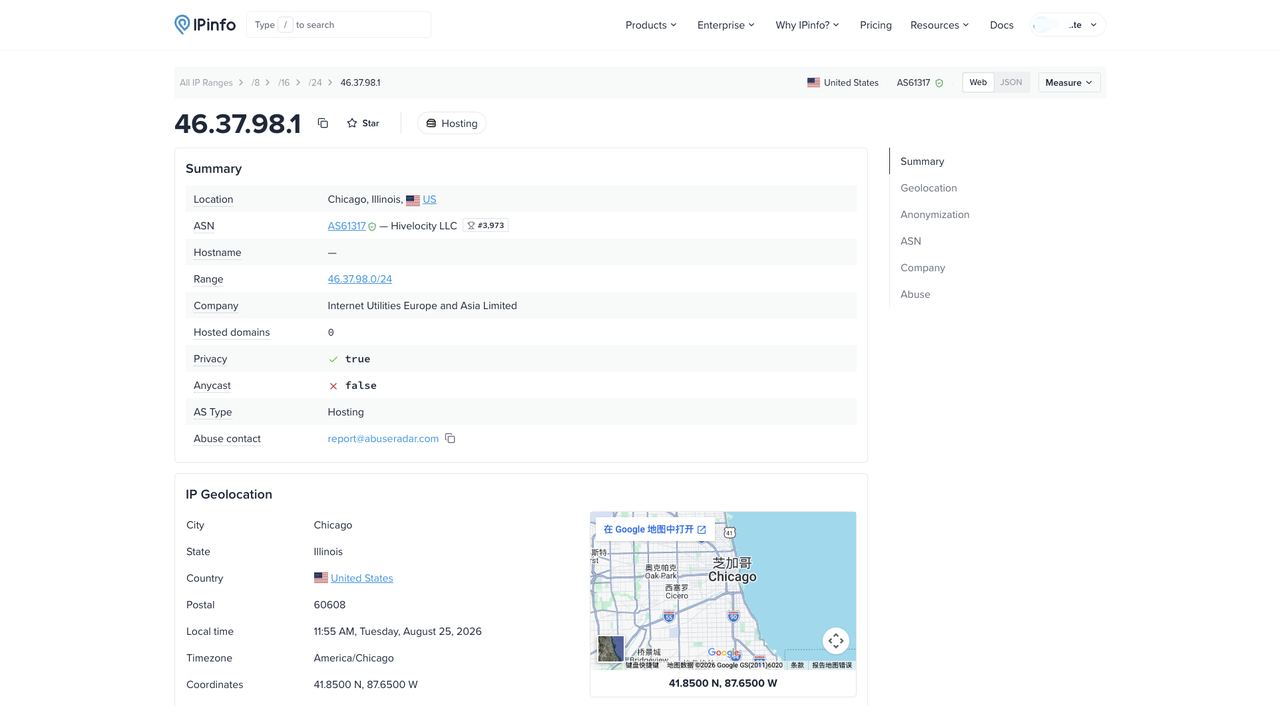
3. Real Test: Same IP, Two Databases, Different Results
We looked up the same IP in IPinfo and IP2Location and the results differed — a direct example of “different data sources producing different displays.”
A common misconception to add: “what a detection website shows” and “what the target platform actually identifies” can also differ. Reasons include:
- Different platforms use different GeoIP data sources
- Data update cycles differ
- Some platforms may use their own IP-location or risk data
So IPinfo, MaxMind, IP2Location and a given platform showing different cities — or even different regions — doesn’t necessarily mean the IP itself changed. For precise checks, cross-check with multiple detection tools instead of trusting a single result.
4. When to Worry, When It’s Usually Fine
Common situations (usually no concern):
- Country-level matches and only the city differs — usually a common GeoIP data difference, not necessarily a sign of a bad IP
- Different detection platforms show different cities (different databases)
- Display refreshes only after some time (database update cycle)
Situations worth investigating:
- The country itself is wrong (e.g., a US IP showing China)
- Location jumps frequently between countries
- Multiple mainstream databases persistently show the same clear error
Note: city-level deviation is common, but whether it affects your business depends on the scenario — some region-sensitive businesses do have city-level requirements. If there’s a clear country-level error, contact the provider to verify IP ownership.
5. FAQ
Q: The detected region differs from the region I bought — is it a fake IP?
A: Country matches with a different city usually doesn’t mean a bad IP — it’s mostly GeoIP data difference; if the country-level is clearly wrong, or multiple mainstream databases persistently show errors, then contact the provider to verify.
Q: Why do different detection websites show different IP regions?
A: Different sites use different third-party geolocation databases with different data sources and update frequencies, so the same IP may display differently. This is common industry behavior, not a sign of a bad IP.
Q: Does inaccurate geolocation affect usage?
A: For most ordinary access scenarios, city-level GeoIP deviation usually doesn’t directly affect web access; but some region-sensitive platforms or businesses may factor IP geolocation into their judgment — so test against your actual business.
6. Summary
IP geolocation is a mapping result from third-party databases/platforms over IP network info, not an inherent IP attribute — different data sources and update lag cause deviations, and city-level deviation is common. The judging standard: country-level is usually more stable than city-level; different databases can differ; city deviation doesn’t necessarily affect business; a clearly wrong country-level is more worth investigating. For precise checks, cross-confirm with multiple tools.
To understand how to judge IP type and ownership, see Native IP vs Datacenter IP. For a stable exit environment with clear ownership, IPNut‘s Static Residential ISP and Static Datacenter IPs are available by region; contact support anytime for location-related questions.