

Running an Instagram content matrix (main + vertical accounts) or e-commerce matrix (brand + shop tags), network-environment planning directly affects daily operations. This article starts from Instagram’s own account structure: choosing account types, how Facebook/Meta linkage affects planning, how matrices are organized, then network priorities per role. It doesn’t cover platform review rules or promise “account safety” — follow Meta’s rules; the network environment is just operational infrastructure.
1. First Understand the Instagram Account Structure
Instagram matrices organize differently from Facebook (FB revolves around profiles + Pages + BM; IG revolves more around account personal/creator identity):
- Account types: Instagram’s common account types include Personal, Creator, and Business, with different professional tools and business features (professional dashboard, analytics, contact buttons, shop tags, etc.) — per the account’s currently available features and region
- Registration and accounts: specific registration methods and account features follow the current region and official flow
- Typical matrix organization: content accounts (by vertical/Reels direction), brand/business accounts (with shop tags), DM customer-service/conversion accounts, sometimes paired with Threads for content coordination
2. Instagram × Facebook / Meta Asset Linkage (An IG-Specific Planning Dimension)
IG accounts can link to Facebook accounts via Account Center for cross-platform management — this adds an IG-specific judgment dimension:
- If the Instagram account and the Facebook Page / Meta Business assets belong to the same brand and business line, treat them as one business environment and plan together
- If they serve different brands, clients, or business projects, maintain separate network and browser environments accordingly
Instagram-Facebook business-asset relationships affect environment planning — the same team may run “an IG brand account + its matching FB Page” around one brand, usually planned together; when managing multiple clients, each client’s assets are maintained separately.
3. Common Instagram Matrix Composition
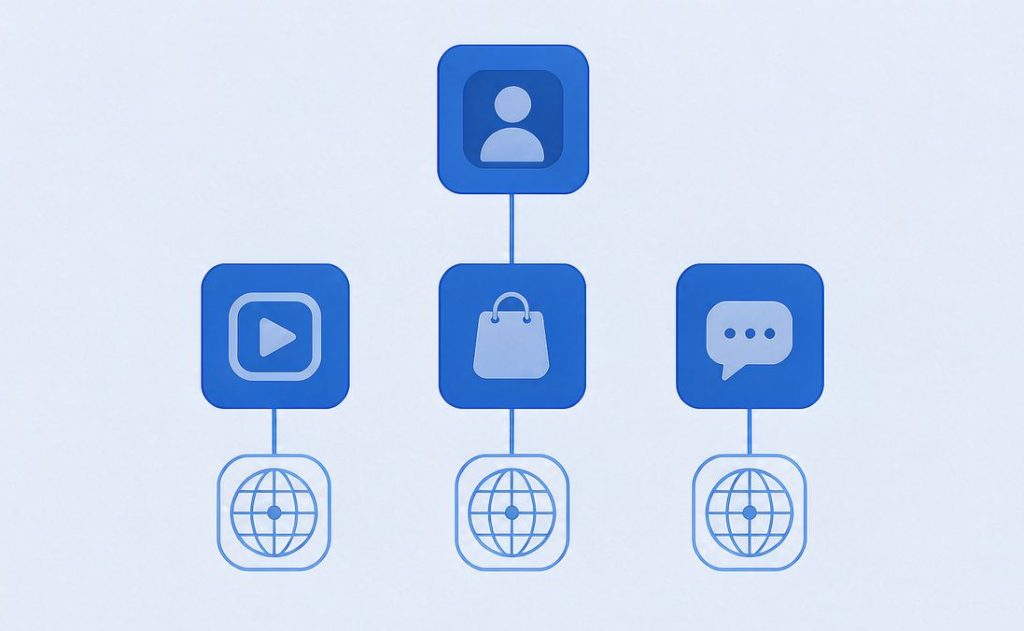
Typical IG matrices organize by account role:
- Main account (Personal/Creator): personal brand or the matrix’s main identity; content and engagement core
- Vertical content accounts (Reels-focused): one per vertical (fashion, food, travel, etc.); the workhorse for matrix growth
- Brand/business account (Business + shop tag): commerce or brand image, with shopping tags and product content
- DM customer-service / conversion accounts: handle inquiries and conversion; role differs from content accounts
- Accounts that run live streaming: for live commerce/collabs; network needs assessed separately
4. Network Planning: Around Roles and Business Relationships, Not “One Account One IP”
Platform judgment is multi-dimensional — sharing IPs doesn’t mean guaranteed association; independent IPs don’t guarantee non-association. The key to IG network planning isn’t mechanically following “one account, one IP” — it’s clarifying account roles, brand ownership, Meta asset relationships, and team usage, then deciding whether independent exits are needed.
| IG account role | Network priority |
|---|---|
| Main / personal creator account | Stable environment, long-term consistency |
| Vertical content accounts | Grouped by vertical with clear records |
| Brand/business account (with shop tag) | Clear business ownership, fixed exit |
| DM customer-service / conversion account | Plan separately from content accounts |
| Accounts running live streaming | Upload bandwidth, latency, packet loss, push-stream link first |
A practical judgment: multiple Instagram accounts under the same brand and team, operating normally, can share a planned network environment per business relationships; accounts belonging to different brands, clients, or needing separate management can consider independent exits — independent exits are a management approach, not an Instagram platform requirement.
5. IG Reels and Live: Network Notes
- Reels uploads: long/high-res Reels uploads depend on stable bandwidth — prioritize actual upload bandwidth and connection stability over IP type
- IG Live: live stability depends on upload bandwidth, latency, packet loss, and the push-stream link; if live lag occurs, prioritize checking upload bandwidth and the line, not first changing IP — a fixed IP only stabilizes the exit; it can’t replace live-stream bandwidth and line quality (there’s no such thing as “residential IP improves live quality”)
6. FAQ
Q: Can Instagram and Facebook accounts share an IP?
A: Yes. If they belong to the same brand and business line, plan them together (an IG brand account + its matching FB Page are often managed together); different brands or client projects can be managed separately.
Q: Does every IG account need its own independent IP?
A: Multiple accounts under the same brand and team, operating normally, don’t necessarily need per-account independent IPs; if accounts belong to different brands, clients, or business lines and you want separate network management, plan independent exits — “one account, one IP” is just a management approach, not an Instagram platform requirement.
Q: Do Creator and Business accounts have different network needs?
A: From the proxy-network perspective, there’s no universal “must use different IPs” rule between Creator and Business. Actual network needs depend mainly on account purpose, team management style, and business scenario.
Q: Will changing IP help with IG Live lag?
A: If the problem comes from the network line or exit quality, replanning the network may help; but lag should first be checked against upload bandwidth, latency, packet loss, and the push-stream link — IP type itself can’t replace a stable live-stream network.
7. Summary
Instagram matrices are typically organized around main + vertical content + brand/business + DM conversion accounts, and the network environment is planned by account role and business relationship (including Meta linkage). The full logic:
Account role → Business relationship (incl. Meta linkage) → Network environment → Live / Reels needs → Environment recordsThe key isn’t mechanically following “one account, one IP” — clarify account roles, brand ownership, Meta asset relationships, and team usage first, then decide whether independent exits are needed. The network environment is operational infrastructure — content quality and compliant operations are the root (team record standards in the team multi-account IP plan; overall Meta thinking in the Facebook multi-account network management).
For a fixed, stable exit: if you only need a fixed exit → Static Datacenter IPs usually suffice (available at IPNut); if you need extra ISP/residential network-source attributes → consider Static Residential ISP. A matrix runs long-term when environments are orderly and responsibilities are clear — account count alone solves nothing.