



Running a TikTok content matrix (multiple accounts across verticals/markets) or an e-commerce matrix (store + creators), network-environment planning directly affects daily operations. This article starts from TikTok’s own account system: Personal/Business/Organization accounts, content matrices, and TikTok Shop role relationships, then the network priorities per role. It doesn’t cover platform review rules or promise “account safety” — follow TikTok and TikTok Shop rules; the network environment is just operational infrastructure.
1. First Understand the TikTok Account System: How Matrices Are Built
TikTok multi-account matrices differ from Facebook-style platforms — they’re organized around content verticals, account types, and e-commerce roles:
- Account types: TikTok mainly offers Personal Account, Business Account, and Organization Account; different types have different features and use cases (per current region and official rules)
- Registration: TikTok accounts can be registered/logged in via phone number, email, and other methods — per current region and official flow
- Content matrices: most teams organize by content vertical (beauty, home, 3C accounts) or regional market (US accounts, Southeast Asia, UK)
- E-commerce matrices: commerce teams involve the TikTok Shop system — store and content accounts have different responsibilities, so network planning follows business relationships
2. TikTok Shop Role Relationships: Not Ordinary “Multi-Accounts”
TikTok Shop’s store account system differs from ordinary content accounts. A typical responsibility chain:
Shop → Official Account → Marketing / Creator Account- The store is the operating entity, the Official Account represents the store identity, and marketing/creator accounts handle content and conversion
- Different roles have different duties, so the network environment should be planned by business relationship, not mechanically by “one account, one IP”
- For deeper store-and-content planning, see the TikTok Shop cross-border network guide
Why are Shop accounts different from ordinary content accounts? Shop-related accounts carry store operations, product content, and conversion — not just content publishing. So beyond region, the network environment should also reflect the business correspondence between Seller Center, content accounts, and team members.
3. Network Planning for TikTok Multi-Accounts
Platform judgment is multi-dimensional — sharing IPs doesn’t mean guaranteed association; independent IPs don’t guarantee non-association. TikTok network planning should first consider account role, business ownership, and actual usage, then decide whether independent exits are needed.
Network priorities by role:
| TikTok role | Network priority |
|---|---|
| Content-matrix accounts | Clear environment, long-term stability |
| Business / brand accounts | Clear business ownership, fixed exit |
| Shop Official Account | Stable store-business environment |
| Marketing / Creator accounts | Plan per team and business relationships |
| Live-stream accounts | Upload bandwidth, latency, packet loss, push-stream link first |
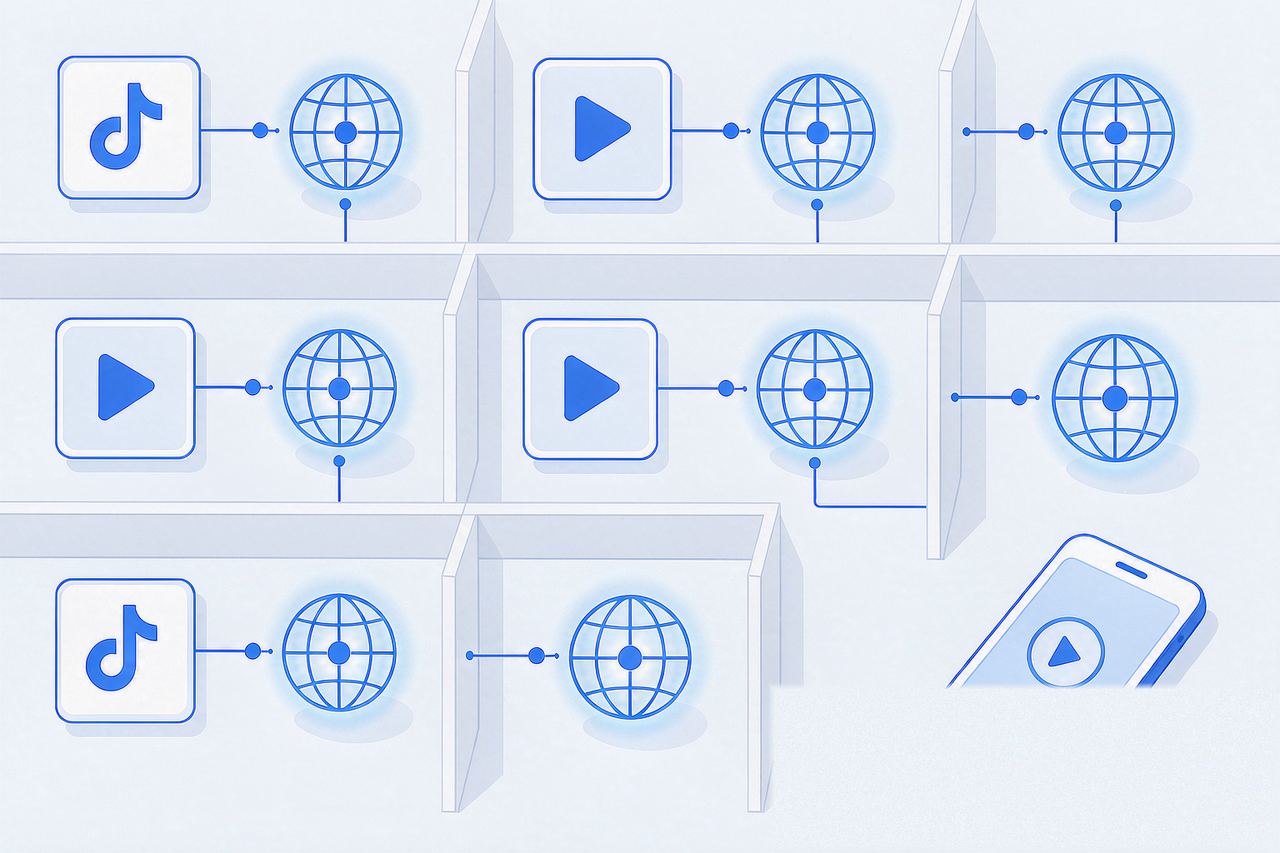
On “independent IPs”: independent exits are a network-environment management approach, not a platform mandate. The core of matrix operations is keeping each role’s account environment clear and manageable — roles needing separate management (different brands, different clients) can plan independent exits; roles in the same business line/team can be planned together per actual operations.
4. Live-Stream Accounts: Network Notes
Live stability depends on upload bandwidth, latency, packet loss, and the push-stream link. If live streaming drops, stutters, or push-stream interrupts, prioritize checking upload bandwidth, packet loss, and line quality — don’t first change the IP. A fixed IP mainly stabilizes the exit; it can’t replace the bandwidth and line quality live streaming needs.
5. FAQ
Q: Do TikTok Shop Official Accounts and creator accounts need separate IPs?
A: Not necessarily. Whether independent exits are needed depends on store structure, team management style, and actual business relationships. The key is clear account-environment-person correspondence, not mechanically following “one account, one IP.”
Q: TikTok live-stream lag — will changing IP help?
A: If the problem comes from the network line or exit quality, replanning the network environment may help; but lag should first be checked against upload bandwidth, latency, packet loss, and the push-stream link — IP type itself can’t replace a stable live-stream network.
Q: Can multiple TikTok accounts use the same IP?
A: Yes — suitability depends on the business environment and management style. A team sharing a normal office network exit doesn’t mean accounts will definitely be identified as associated; plan independent exits only when separate management is needed.
Q: Does IP isolation guarantee accounts never get associated?
A: No. The network environment is one layer of multi-dimensional platform judgment; no single practice can “guarantee” an outcome.
Q: How should I plan networks for a large matrix?
A: Allocate by account role and business priority: Shop Official Accounts and core brand accounts get stable environments and clear ownership first; content-matrix accounts are grouped by vertical with clear records.
6. Summary
TikTok matrices are usually organized around content verticals, regional markets, brands, or store businesses, and the network environment is planned by account role and business relationship. The full logic:
Account role → Business relationship → Network environment → Live-stream / Shop needs → Environment recordsWhether a multi-account matrix needs independent IPs depends on roles and business relationships; live-stream and Shop scenarios have their own network priorities. The network environment is operational infrastructure — content quality, product operations, and rule compliance are the root (team record standards in the team multi-account IP plan).
For a fixed, stable exit: if you only need a fixed exit → Static Datacenter IPs usually suffice (available at IPNut); if you need extra ISP/residential network-source attributes → consider Static Residential ISP. What multi-account isolation really needs is a clear boundary around each account — not more exit types.