



“Static residential ISP proxy” is an increasingly common term, but many people can’t tell how it differs from rotating residential proxies. This article answers three questions: what a static residential ISP proxy is, its essential difference from rotating residential proxies, and which to choose for which scenario. “Rotating residential proxies” are referenced here as an industry product category for educational comparison only (IPNut does not currently offer rotating residential plans).
1. What Is a Static Residential ISP Proxy
A static residential ISP proxy is typically a proxy IP with residential network attributes, belonging to a local ISP network, provided to users for long-term use with a fixed exit. It emphasizes the IP’s stability and long-term consistency.
One-line understanding: it’s a residential-attribute proxy “belonging to a local ISP network, provided long-term with a fixed exit” — the core is a fixed exit that stays unchanged long-term.
Note: an IP belonging to an ISP network is a network-attribute concept; “provided long-term with a fixed exit” is how the proxy product is delivered — the two are not the same thing.
2. The Essential Difference from Rotating Residential Proxies
| Dimension | Static Residential ISP | Rotating Residential Proxy |
|---|---|---|
| Exit IP | Fixed exit, long-term use | Dynamically selected/rotated exits from a residential IP pool |
| Usage mode | Usually held per IP long-term | Obtained per traffic/session |
| Exit consistency | Long-term consistent; more stable exit environment | Exit changes/rotates |
| Typical scenarios | Account operations, store management | Data scraping, ad verification |
The essential difference: static = fixed exit + long-term consistency; rotating = exits that change/rotate. They serve different needs — the former pursues “stability,” the latter pursues “exit variation.”
3. Which to Choose for Which Scenario
Businesses usually better suited to static residential ISP:
- Account operations needing long-term login, fixed regions, and consistent exits
- E-commerce store management and other scenarios needing a stable login environment
- Businesses needing a long-term fixed exit
Tasks where rotating residential proxies can be considered:
- Data scraping needing many different exits and broad region coverage
- Ad verification with multi-region rotation needs
- Price monitoring and other scenarios needing frequent exit changes
Note: these aren’t hard rules — data scraping doesn’t only work with rotating residential; static residential and datacenter IPs may suit different data tasks too. Also, rotating residential is a common industry category; IPNut currently offers static residential ISP and static datacenter products, not rotating residential plans — judge by your scenario against industry info.
4. Buying and Using a Static Residential ISP (Example: IPNut)
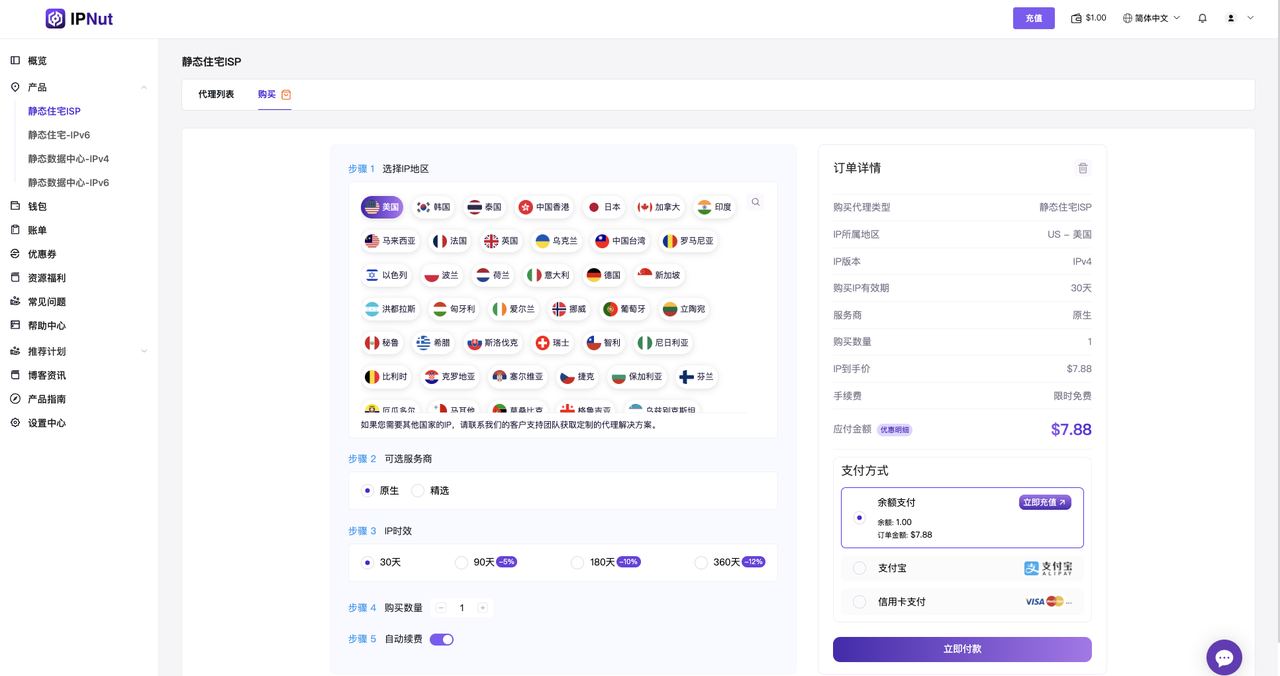
IPNut’s static residential ISP uses a dedicated IP supply model (a product feature of IPNut, not necessarily an industry-wide standard for all static residential ISP providers): the purchase flow is clear — choose region → choose provider tier → choose duration (30-360 days, longer durations get discounts) → choose quantity → confirm auto-renewal. After purchase you get a fixed exit IP manageable in the dashboard.
Usage essentials:
- One account maps to one fixed IP, unchanged long-term
- If your business is sensitive to regional consistency, you can reasonably align timezone/language with the IP region (not a mandatory requirement)
- For other environment dimensions (fingerprint, protocol), see Fingerprint Browser vs Proxy IP and the protocol selection guide
5. FAQ
Q: Is a static residential ISP different from a regular residential IP?
A: Static residential ISP emphasizes fixed exits and ISP/residential network attributes; “residential IP” is a broader industry concept that can include static residential and rotating residential forms. Static residential is one specific form of residential IP.
Q: Static residential ISP costs more than datacenter IPs — is it worth it?
A: Depends on the scenario. For account operations, the environment consistency from residential attributes + fixed exit outweighs the price gap; for pure data tasks, datacenter IPs are more economical. Choose by business need — more expensive isn’t always better.
Q: Does IPNut offer rotating residential proxies?
A: No. IPNut currently provides static residential ISP and static datacenter products (IPv4+IPv6), not rotating residential plans. If you need rotating residential, that’s another industry product type — research it according to your own needs.
6. Summary
Static residential ISP emphasizes residential/ISP network attributes and a fixed exit, suited to scenarios needing long-term exit consistency; rotating residential emphasizes IP pools and exit rotation, suited to tasks needing many different exits or broad region coverage. The essential difference is “fixed exit vs. exit rotation” — account operations usually suit static; for data tasks, choose by need, and don’t be locked into the simple “static = operations, rotating = scraping” division.
For a stable, consistent account-operation environment, IPNut‘s Static Residential ISP offers fixed IPs by region; for data tasks, use Static Datacenter IPs. To identify your IP type, see Native IP vs Datacenter IP.